
Material Comparison
Quartz vs Quartzite
Two words apart by three letters, describing two materials with almost nothing in common beyond the mineral in the name.
Call now for service availability. Please have your 5-digit ZIP code ready.
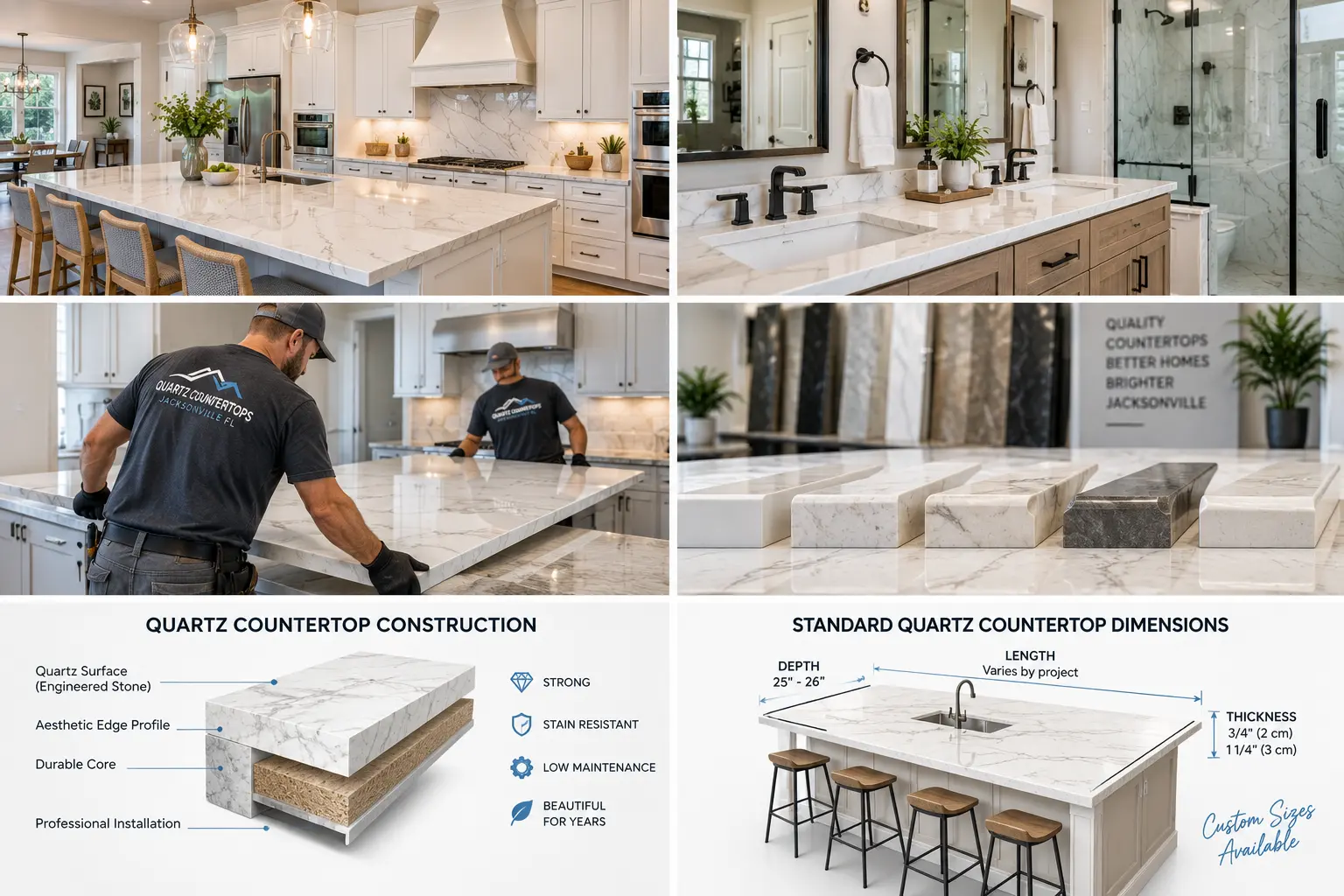
This is the most commonly confused pair in the countertop world, and the confusion has real consequences: buying a quartzite expecting it to need no sealing, or buying a quartz expecting it to be a unique natural slab, leads to disappointment that a five-minute conversation would have prevented.
The Core Difference
| Quartz | Quartzite | |
|---|---|---|
| What it is | Engineered surface, manufactured | Natural quarried metamorphic stone |
| Made from | Ground natural quartz + polymer resin + pigment | Sandstone transformed by heat and pressure |
| Porosity | Nonporous | Porous — varies by slab and finish |
| Sealing | Not required | May require sealing, depending on slab and finish |
| Pattern | Consistent within a collection | Unique to every slab |
| Hardness | Hard and scratch resistant | Very hard — among the hardest countertop stones |
| Heat | Resin is heat-sensitive; use trivets | More heat tolerant; trivets still advised |
| Fabrication | Predictable, standardized | Harder on tooling; more demanding to cut |
| Outdoor use | Not recommended | Generally suitable |
Quartz: Engineered
Quartz countertops are manufactured products. Ground natural quartz is combined with polymer resin and pigment, compacted and cured into slabs of consistent thickness and appearance. Because the resin fills the space between particles, the finished surface has no open pores — nothing to absorb liquid, and nothing for a sealer to penetrate.
The consequence: no sealing, predictable color and pattern, and a wide catalog of designs including looks that do not exist in nature.
Quartzite: Natural Stone
Quartzite starts as sandstone. Heat and pressure over geological time recrystallize the quartz grains into a dense, very hard stone. It is quarried, cut into slabs and finished — no resin, no pigment, no manufacturing of the pattern.
Because it is natural, porosity varies from slab to slab and finish to finish. Many quartzites benefit from sealing; some are dense enough to need very little. The only reliable guide is the specific slab in front of you.
Some material sold as quartzite is actually a softer marble or dolomitic stone. Testing and a reputable supplier matter here — this is a real issue in the natural stone trade.
How They Behave Day to Day
- Spills: quartz resists them by being nonporous; quartzite resists them when properly sealed.
- Knives: quartzite is extremely hard and will dull a blade fast. Use a board on both.
- Heat: quartzite tolerates more; quartz resin does not. Trivets on both.
- Etching: genuine quartzite resists acid etching far better than marble. Quartz does not etch.
- Consistency: quartz matches slab to slab; quartzite does not, so large projects need slab-level planning.
Which Should a Jacksonville Homeowner Choose?
Choose quartz if you want a specific consistent look, zero sealing and a wide design range — particularly if you want a white marble aesthetic indoors.
Choose quartzite if you want genuine natural stone with unique movement, maximum hardness, and you are comfortable with slab-level selection and possible sealing.
We work in residential quartz. If quartzite turns out to be the right material for your project, it is better that you know the difference now than after installation.
Homeowner Questions
Frequently Asked Questions
Is quartzite the same as quartz?
No. Quartz is an engineered, manufactured surface made from ground quartz and resin. Quartzite is a natural quarried stone. They differ in porosity, sealing, pattern and fabrication.
Does quartzite need to be sealed?
It may, depending on the specific slab and finish. Porosity varies in natural stone. Quartz, by contrast, never requires sealing.
Which is harder?
Quartzite is generally harder. Both are highly scratch resistant in normal kitchen use, and both benefit from a cutting board.
Which handles heat better?
Quartzite. Engineered quartz contains polymer resin that can discolor or crack under direct heat, so trivets are essential with quartz.
Why do people confuse them?
The names are nearly identical and both contain the mineral quartz. But one is manufactured and one is quarried, and that difference drives everything else.
Planning New Quartz Countertops?
Tell us about the room, the cabinets and the surface you have now. We will walk through material options, measurement and installation so you know what to expect before anything is ordered.
Call now for service availability. Please have your 5-digit ZIP code ready.
Request Estimate