
Design Guide
Quartz Countertop Colors
Color is the decision homeowners agonize over most and regret least when it is made with a sample in the actual room.
Call now for service availability. Please have your 5-digit ZIP code ready.
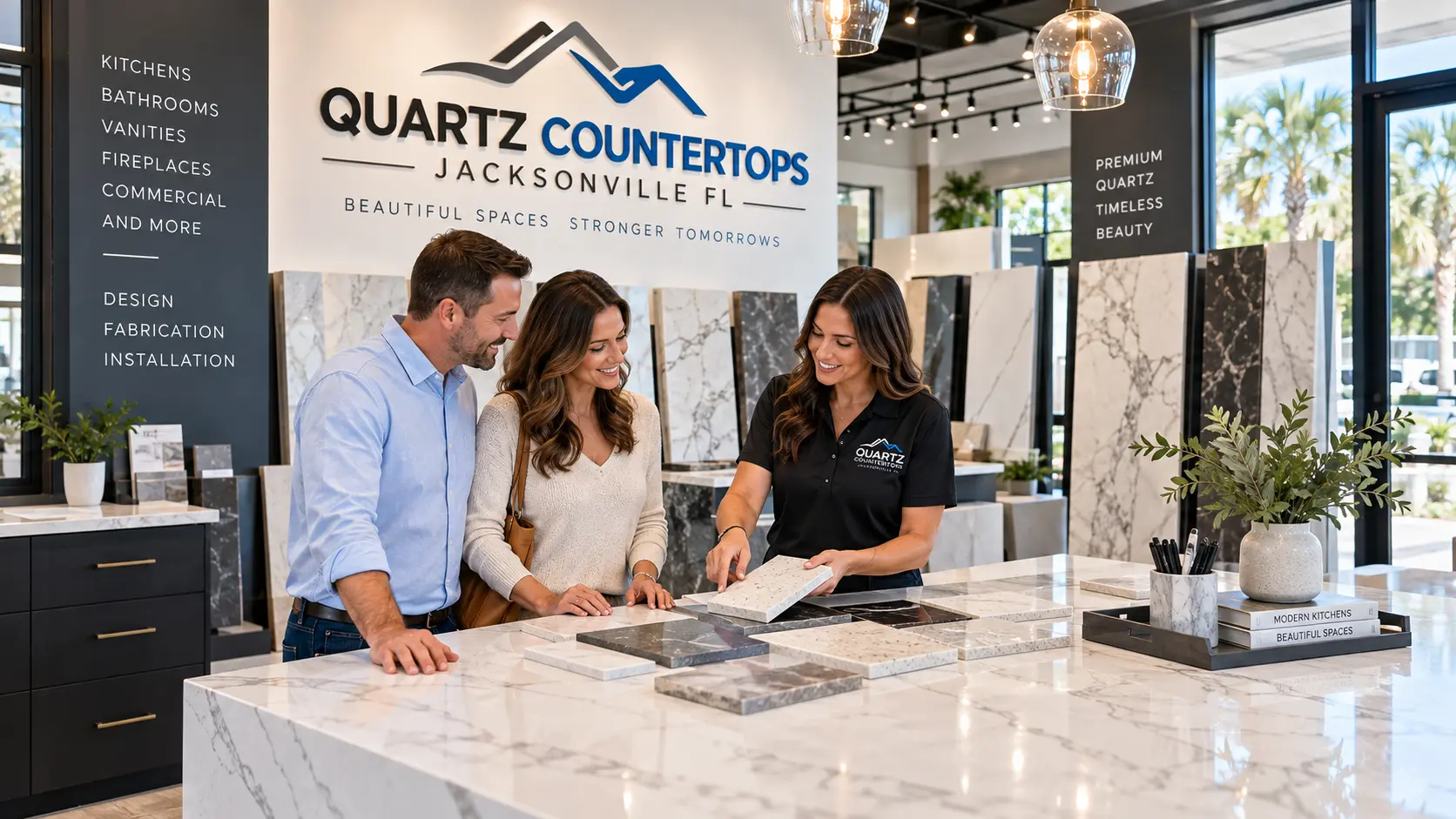
Engineered quartz is manufactured, which means its color and pattern are consistent from one slab to the next within a given collection and production run. That consistency is the main reason people choose it over natural stone when they want the finished kitchen to look like the sample.
The categories below cover most of what you will see in a Jacksonville showroom.
Bright White
Crisp, cool whites with little or no visible pattern. They make small kitchens feel larger and pair cleanly with almost any cabinet color, including navy, black and natural wood. In a room with a lot of south-facing light they can read slightly stark, which some people love and some do not.
More on this family on the white quartz countertops page.
Warm White and Cream
Slightly softened whites with a hint of beige or greige. They flatter oak, maple, hickory and cream-painted cabinetry, and they hide everyday crumbs and water spots better than a cool white. In Jacksonville homes with warm flooring and warm lighting, these often look more natural than a pure white.
Calacatta-Inspired
Bold, directional veining on a white field — the look people mean when they say marble-look quartz. Vein scale varies enormously between collections: some are subtle and linear, others are wide and dramatic. Scale is the thing to evaluate, because a three-inch sample tells you very little about how a nine-foot island will read.
Full guide on the Calacatta quartz page.
Carrara-Inspired
Finer, softer gray veining on a white-to-light-gray background. Quieter than Calacatta patterns and easier to live with in a large kitchen. A common choice when the cabinets or backsplash are already doing visual work.
Gray
Light to mid grays, with or without veining. Mid-gray on white cabinets produces contrast without going dark, and it is forgiving of daily use. Charcoal and near-black quartz look dramatic but show dust, water spots and fingerprints readily, particularly in a polished finish.
Concrete Look
Matte or honed surfaces with soft cloudy mottling. Contemporary and architectural, and increasingly popular in newer Northeast Florida construction. Honed and matte finishes are more prone to showing marks than polished ones, so ask about the specific product's finish behavior.
Soft Beige and Taupe
Neutral earth tones that bridge warm floors and cool cabinets. They work well in transitional kitchens and are among the most forgiving colors for a busy household.
Solid and Minimal Pattern
Near-uniform colors with fine speckling or none at all. These suit minimalist kitchens, laundry rooms and secondary spaces, and they make seams easier to disguise because there is no pattern to align.
How to Actually Choose
- Get physical samples. Screen renderings misrepresent color and vein scale.
- Look at them in your kitchen, against your cabinets, at morning and evening light.
- Put the sample on the counter horizontally, not held vertically — light behaves differently.
- Consider your flooring and backsplash, not just the cabinets.
- If you can, see a full slab before committing to a heavily veined pattern.
Brand and collection availability varies. Ask which quartz products are currently available for your project before settling on a specific name.
Homeowner Questions
Frequently Asked Questions
What quartz color goes with white cabinets?
Nearly all of them, which makes the real question contrast. Warm white creates a soft monochrome look; mid-gray or strong veining creates definition. Compare samples against your actual cabinet doors.
Does quartz color vary between slabs?
Much less than natural stone, but production runs can vary slightly. For large projects requiring multiple slabs, matching the run matters.
Do dark quartz countertops show more?
Dark polished surfaces show dust, water spots and fingerprints more readily than mid-tones. A honed or textured finish changes that behavior in both directions.
How do I judge veining from a small sample?
Samples are useful for evaluating base color, finish and general tone. For quartz with large-scale veining or significant pattern movement, viewing a larger sample or full slab can provide a better understanding of how the finished surface may look — especially for an island.
Does bright Florida light change how colors look?
Yes. Strong natural light flattens subtle patterns and cools warm tones. Always evaluate samples in the room where they will live, at more than one time of day.
Planning New Quartz Countertops?
Tell us about the room, the cabinets and the surface you have now. We will walk through material options, measurement and installation so you know what to expect before anything is ordered.
Call now for service availability. Please have your 5-digit ZIP code ready.
Request Estimate