
Material Comparison
Quartz vs Porcelain Countertops
Porcelain slabs are the newer arrival. They beat quartz on heat and UV, and lose to it on thickness, edges and fabrication forgiveness.
Call now for service availability. Please have your 5-digit ZIP code ready.
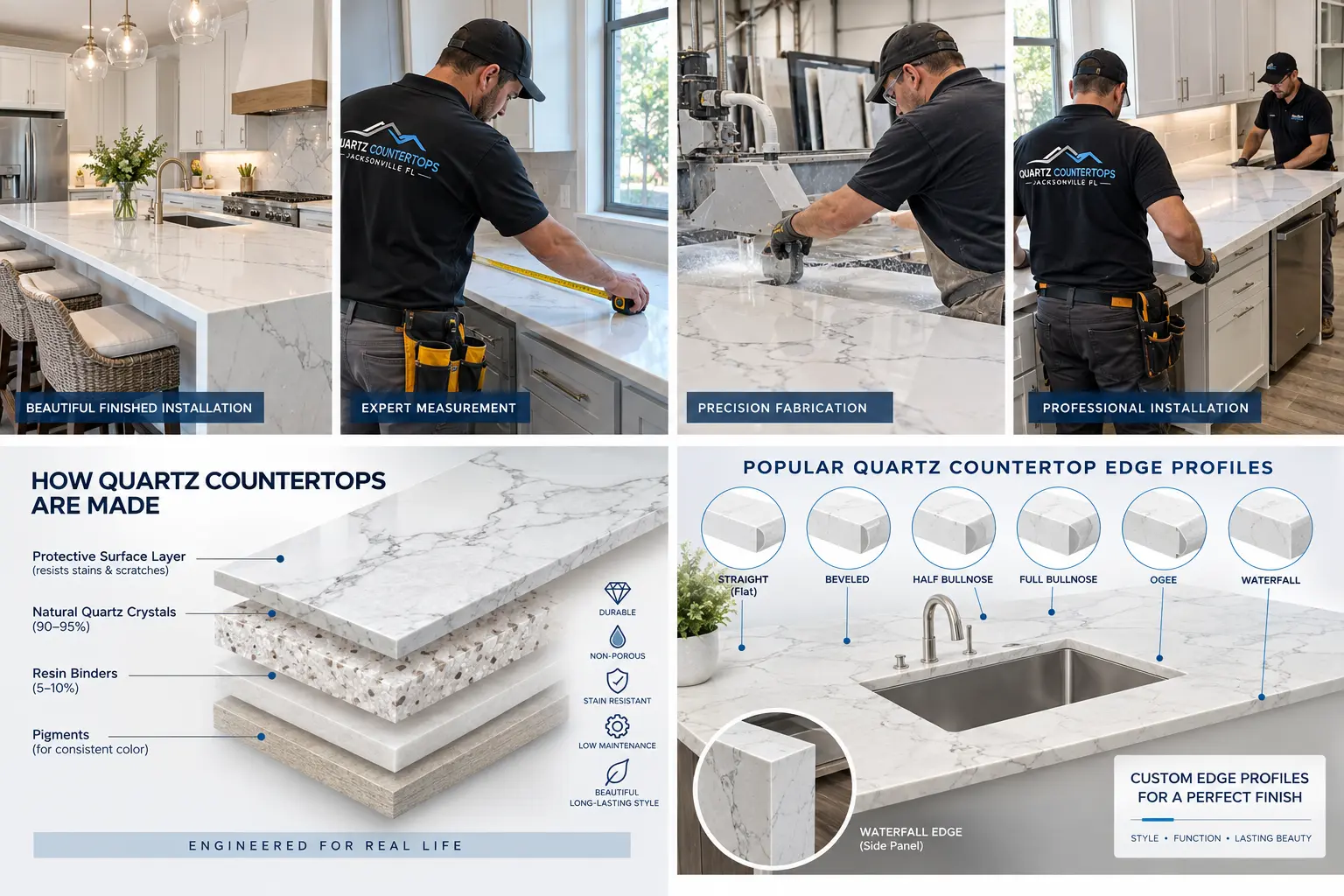
Porcelain countertop slabs are large-format ceramic panels fired at very high temperature, usually with a printed and glazed surface layer. They arrived in residential kitchens relatively recently and are worth understanding, particularly if outdoor or high-heat use is on your list.
Side by Side
| Quartz | Porcelain Slab | |
|---|---|---|
| Composition | Ground quartz + polymer resin | Fired clay and mineral body |
| Typical thickness | 2 cm and 3 cm | 6 mm to 12 mm, sometimes 20 mm |
| Heat resistance | Limited — resin is sensitive | Excellent |
| UV / outdoor | Indoor use recommended | Suitable for outdoor use |
| Pattern depth | Through-body color and veining | Often surface-printed; some through-body |
| Edge options | Wide range including bullnose and ogee | Limited; mitered edges are typical |
| Fabrication | Established, forgiving | Demanding; risk of chipping at cuts |
| Undermount sinks | Straightforward | Requires specific detailing |
| Scratch resistance | High | Very high on the glazed surface |
Where Porcelain Is Genuinely Better
- Heat. A hot pan on porcelain is a non-event. That is a real advantage over quartz.
- UV stability. Porcelain is suitable outdoors, where we do not recommend quartz.
- Very thin profiles. A 6 mm slab enables designs quartz cannot match.
- Large-format panels. Useful for seamless wall cladding as well as countertops.
Where Quartz Is Better for Most Kitchens
- Edge profiles. Quartz supports the full range; porcelain is largely limited to mitered edges because the body is thin.
- Through-body pattern. Many porcelains print the pattern on the surface, so a chip can expose a different color beneath. Quartz color runs through.
- Substantial edge. A three-centimeter quartz edge reads solid without a build-up.
- Fabrication risk. Porcelain is less forgiving at cutouts; skilled fabrication is essential.
- Availability and familiarity. Quartz has a far wider residential catalog and a deeper installer base.
What About Sintered Stone?
Products marketed as sintered stone sit in the same family as porcelain slabs — mineral particles fused under heat and pressure. They share the heat and UV advantages and the fabrication demands. The comparison to quartz runs along the same lines.
For a covered outdoor kitchen in Florida, porcelain or a UV-stable natural stone is the right conversation. Quartz belongs indoors.
The Practical Verdict
For an indoor residential kitchen or bath in Jacksonville, quartz remains the more practical choice for most homeowners: a wider design catalog, better edge options, through-body color and a well-established fabrication and installation process. Porcelain earns its place where heat or sun exposure is the governing requirement.
Homeowner Questions
Frequently Asked Questions
Is porcelain better than quartz for countertops?
It depends on the requirement. Porcelain is better for heat and outdoor exposure. Quartz is generally better for indoor kitchens thanks to edge options, through-body color and a wider design range.
Can you put hot pans on porcelain?
Porcelain handles heat very well. Quartz does not — its resin binder is heat-sensitive, so trivets are required.
Does porcelain chip?
It can chip at edges and cutouts, and on surface-printed products a chip may reveal a different color beneath. Skilled fabrication matters a great deal.
Can porcelain be used outdoors in Florida?
Yes, porcelain is UV stable and suitable for exterior use. We do not recommend quartz outdoors because of its resin content.
Which costs more?
The ranges overlap. Porcelain often carries higher fabrication costs because of the care required, which can offset a lower material price.
Planning New Quartz Countertops?
Tell us about the room, the cabinets and the surface you have now. We will walk through material options, measurement and installation so you know what to expect before anything is ordered.
Call now for service availability. Please have your 5-digit ZIP code ready.
Request Estimate